Author: ZiggyZog Team
Play Is How Children Practise Thinking
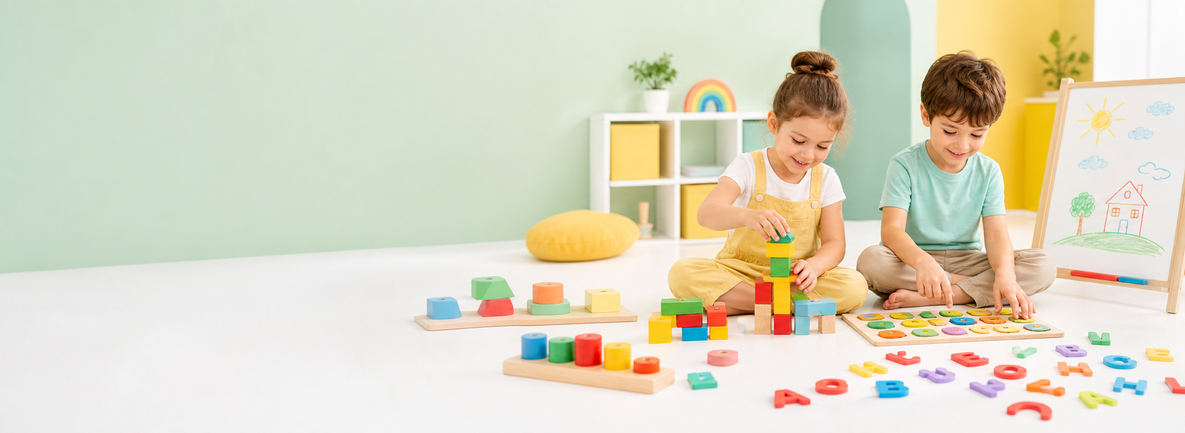
For children, play is not just a break from learning. It is one of the most natural ways to understand the world. A child who stacks blocks, rolls a car, sorts colours, pretends to cook, presses musical keys or solves a puzzle is quietly practising attention, memory, imagination and decision-making. The right toys give children small, enjoyable challenges that make them curious and confident.
Good toys do not need to be expensive or complicated. A simple shape sorter can introduce matching and problem-solving. A set of vehicles can start a story. A pretend-play kitchen can help a child copy real-life routines and build language. A drawing board can turn one idea into many. What matters most is whether the toy gives the child something active to do, think about and repeat in new ways.
Problem-Solving Starts With Small Experiments
Many toys encourage children to try, fail, adjust and try again. When a puzzle piece does not fit, the child learns to rotate it. When a tower falls, the child tries a wider base. When a pull-back car does not travel far, the child experiments with the surface or the strength of the pull. These small experiments can support flexible thinking because children learn that there is often more than one way to solve a problem.
This is why open-ended toys are so valuable. Building sets, creative kits, pretend-play toys and simple activity toys allow children to make choices instead of only following one fixed result. The child becomes part of the play, not just a viewer. That active role is what makes play feel meaningful.
Imagination Builds Language and Confidence
Children often talk while they play, even when they are playing alone. A toy car becomes a rescue vehicle. A doll becomes a patient. A toy kitchen becomes a family meal. These little stories help children practise words, emotions, conversations and everyday social behaviour. They also allow children to express ideas that may be difficult to explain directly.
Pretend play can be especially helpful when adults join gently. Instead of taking over the game, parents can ask simple questions such as “Where is the car going?” or “Who are you making tea for?” This gives the child space to lead while also encouraging new vocabulary and storytelling.
Hands-On Toys Support Motor Skills
Children’s minds and bodies develop together. When a child presses buttons, turns knobs, holds crayons, balances blocks, threads beads or fits shapes, they practise hand control and coordination. Active toys can also encourage movement, balance and body awareness. These skills may look small from the outside, but they can help children feel more independent in daily activities.
For younger children, choose toys that are easy to grip and clearly age-appropriate. For older children, look for toys that involve planning, assembling, designing or controlled movement. Always check the product’s age guidance and avoid toys with small parts for children who are too young for them.
Creative Toys Help Children Express Their Own Ideas
Art boards, musical toys, craft activities and construction toys give children permission to make something personal. There is no single correct answer when a child draws a house, creates a pattern, builds a vehicle or makes a pretend song. This freedom can support confidence because the child learns that their ideas have value.
Creative play also teaches patience. A child may need to erase, rebuild, recolour or restart. Over time, this helps them stay with a task a little longer. The aim is not perfection. The aim is joyful practice.
Choosing Toys by Age and Interest
A useful toy should match the child’s stage, interests and attention span. For ages 2–4, look for bright, sturdy toys that support sorting, pretend play, music, movement and simple cause-and-effect. For ages 5–7, puzzles, vehicles, creative boards, pretend-play sets and beginner learning toys often work well. For ages 8–12, children may enjoy toys that involve strategy, design, building, collection or more detailed role play. For 12+ children, gifts that feel grown-up, creative, skill-based or interactive may be more suitable.
Budget also matters. A thoughtful toy under ₹500 can be more useful than an expensive toy that the child quickly ignores. Try to choose gifts that invite repeat play instead of only one-time excitement.
Balance Toys With Real Interaction
Toys are helpful, but they work best when children also get time, attention and encouragement. A parent, grandparent or older sibling can make even a simple toy more valuable by asking questions, listening to the child’s story or playing for a few minutes together. Children do not need constant entertainment. They need safe chances to explore, imagine and feel proud of what they create.
Need Help Choosing a Development-Friendly Gift?
If you are buying a birthday gift, return gift or everyday surprise, start with the child’s age, interests and your budget. ZiggyZog can help you browse toys and gifts that feel fun, thoughtful and practical. Selected products may also be available for same-day delivery in eligible Dehradun locations.
Shop Learning & Creative Toys | Chat on WhatsApp
Frequently Asked Questions
Can toys help with learning?
Yes. Suitable toys can support observation, memory, problem-solving, creativity and language through active play.
Are expensive toys always better?
No. A simple, age-appropriate toy that a child uses in many ways can be more valuable than a costly toy with limited play value.
How do I choose the right toy?
Check the child’s age, safety guidance, interests and the type of play the toy encourages. When unsure, choose toys that allow children to create, build, imagine or solve small problems.
Can ZiggyZog help me select a gift?
Yes. Share the child’s age, occasion and budget on WhatsApp, and the team can help you shortlist suitable options.